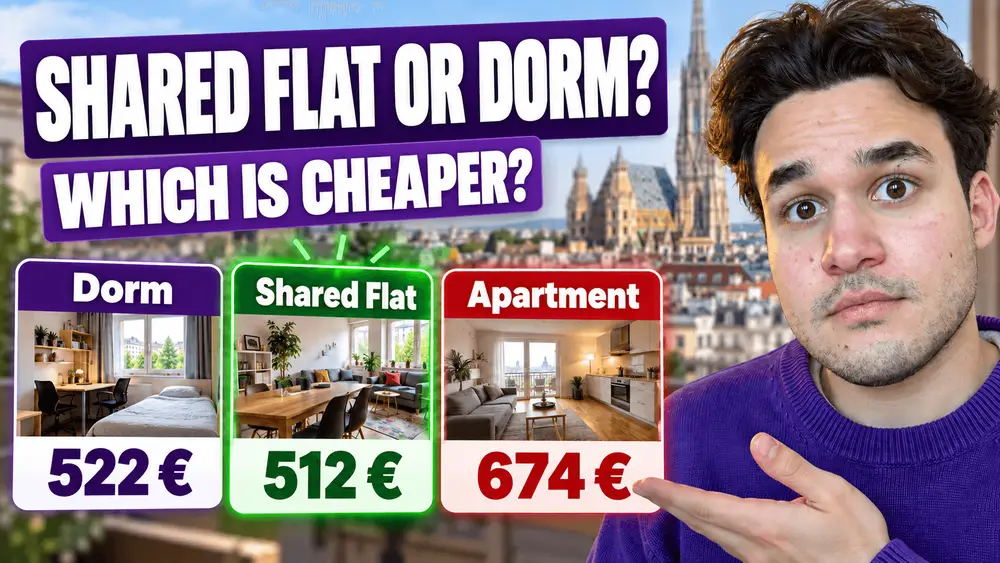
Student dorm, shared flat, or your own apartment? If you’re moving to Vienna to study, the choice affects not only your privacy and how you live with others, but above all your monthly budget. And the option that seems cheapest at first glance is not necessarily the one that costs the least: according to the Student Social Survey, dorms and shared flats are almost level on average in Vienna. [1]
Quick answer:
- Students at Vienna universities paid an average of €522 for student accommodation, €512 for a shared flat, and €674 for a single-person household in 2025. [1]
- If you’re looking in 2026, you may find significantly higher prices, especially for private apartments on the open market.
- Student accommodation often offers predictable costs, but places for the winter semester are usually filled quickly. (Based on personal experience.)
- Your own apartment offers the most privacy, but usually requires the highest budget and the most organisational effort.
Prices and rules last checked: September 2026.
The three housing options at a glance
The best basis for comparison is the IHS Student Social Survey 2025. It records what students actually pay each month for their housing, including housing-related costs and, where applicable, mortgage repayments. For students studying at a higher education institution in Vienna, the average figures are:
Housing type | Average monthly housing costs in Vienna | What you get |
|---|---|---|
Student dorm | €522 | private or shared room, often furnished, utilities frequently included |
Shared flat | €512 | private room, shared kitchen and bathroom |
Own apartment | €674 | maximum privacy, your own household |
One important surprise: student accommodation was not cheaper on average than a shared flat. The difference was just ten euros. According to the IHS, one reason for the relatively high cost of student accommodation in Vienna is the large number of private and commercial operators, which are often more expensive than non-profit providers. [1] That does not mean you can easily find your own apartment for €674 today. The survey includes students with existing rental agreements and different types of housing. In other words, it measures actual housing costs in 2025, not current asking rents for new leases. You can check the current apartment rental prices (asking rents) in Vienna on Lystio.
That distinction matters if you’re only just starting your housing search.
How much student accommodation costs in Vienna
The biggest advantage of student accommodation is predictability. In many residences, electricity, heating and sometimes internet are already included in the monthly price. That means you do not have to organise an electricity contract, internet connection or the split of utility costs yourself.
At WIHAST, published prices for the 2026/27 academic year start, for example, at €320 per place in Hainburgerstraße. Depending on the residence, single rooms start at around €407 to €467. At the Hirschengasse residence, for example, a single room starts at €467 per month and a twin room at €374. According to the operator, the listed prices include all additional costs such as electricity and heating. WIHAST also charges a €600 deposit when you first move in. [2]
That does not mean all student residences fall within this price range. The operator, location, room size, whether it is a single or shared room, and the level of amenities can all have a significant impact on price.
At the moment, however, the bigger bottleneck is not necessarily the price, but availability. OeAD Student Housing reports that its Vienna accommodation is fully booked for the 2026 winter semester. Home4students also states that places for the 2026/27 winter semester have already been allocated. At Home4students, the application date is one of the factors used to determine priority. [3] [4]
If you start your studies in autumn, you should therefore not wait until September to look for a place in a student residence. Student accommodation works particularly well if you can plan early, are new to Vienna and want to keep organisational effort to a minimum.
How much a room in a shared flat or your own apartment costs
A shared flat can be financially similar to student accommodation, but the living experience is different. You usually have your own room while sharing the kitchen, bathroom and sometimes the living room with others. According to the IHS, students in shared flats in Vienna paid an average of €512 per month in 2025. [1]
If you are looking now, it makes sense to budget a little more. On student-focused platforms, currently advertised rooms in shared flats can be significantly more expensive. However, these figures are always just a snapshot of the rental market and not an official average. [5]
With a shared flat, you should therefore look beyond the headline price in the listing. What matters is what is included: operating costs, electricity, heating and internet may already be part of the price, or they may be charged separately.
The difference becomes even larger with your own apartment. According to the IHS, students in Vienna who already live alone have average housing costs of €674 per month. [1]
On the current rental market, however, advertised apartments are considerably more expensive. In a Lystio analysis of 13,817 rental listings in Vienna, the median asking rent was €1,199, or €21.38 per square metre. [6] This figure covers the broader Vienna rental market, including apartments from around 30 m² to 200 m², rather than specifically small student apartments. It is therefore not directly comparable with the €674 from the Student Social Survey. But it does show why renting a new apartment on the open market in Vienna can quickly become expensive for students.
A simple budget example makes the difference clear.
Assumption: You have €1,200 available per month. For this comparison, we use the actual average housing costs recorded by the IHS for Vienna in 2025. [1]
Housing type | Housing costs | Left from €1,200 |
|---|---|---|
Student dorm | €522 | €678 |
Shared flat | €512 | €688 |
Own apartment | €674 | €526 |
From that remaining amount, you still need to pay for food, public transport, your phone, study-related expenses, leisure and everything else. If the only apartment you can find is close to Vienna’s current median asking rent, a monthly budget of €1,200 is almost entirely used up by housing alone. [6]
Which housing option suits your situation
Student accommodation is particularly suitable when you are just starting university. It requires relatively little organisation, makes it easier to meet other students, and many ongoing costs are already bundled into one payment. The downside is that you have less freedom when it comes to choosing your room and house rules, and above all, you need to secure a place early enough.
A shared flat is often the best middle ground between cost and independence. You have more choice over the location and the people you live with than in a student residence, while sharing the major costs of an apartment. At the same time, a lot depends on whether the people in the flat actually get along and how the rental agreement is structured.
Your own apartment gives you the most privacy. At the same time, you cover the rent and ongoing costs on your own. It is also easy to underestimate how difficult it can be, especially for students who did not grow up in Vienna, to build a social circle. For students on a tight budget, a newly rented apartment on Vienna’s open market is therefore usually the most difficult option.
There is also an important difference when it comes to housing benefit: people living in a residence that qualifies as a “Heim” under Vienna’s housing legislation are generally not entitled to Vienna housing benefit. For a regular apartment, requirements relating to main residence, household and tenancy must be met, among other things. [7] [8]
In a shared flat, you should pay particular attention to the rental agreement. Vienna’s housing benefit rules link eligibility to specific tenancy requirements. If you are only subletting a single room, you should therefore not automatically assume that you are eligible for housing benefit. [8]
There is also a fourth, longer-term option: subsidised housing and municipal housing. These can be attractive in terms of price, but they are not a quick alternative for everyone who is moving to Vienna for their first semester.
The Vienna Housing Ticket has specific requirements relating to age, main residence and residence status. Depending on the type of housing, additional conditions may apply. [9]
What you can do now
- Set your maximum housing budget first. Do not look only at the rent. Include electricity, heating, internet and one-off costs such as the deposit. If there is barely any money left for food, public transport and everyday expenses, the apartment is too expensive, even if you can technically afford the rent.
- Look for a student residence and a shared flat at the same time. Especially before the winter semester, you should not rely on a single option. Apply to several student residences early and keep an eye on available rooms in shared flats at the same time.
- Only then compare private apartments. If your budget allows it or you deliberately want to live alone, filter for smaller apartments and always compare the actual total monthly cost. On Lystio, you can view current rental apartments in Vienna directly on the map.
Frequently asked questions
There is no clear winner. According to the 2025 Student Social Survey, students in shared flats paid an average of €512 per month, compared with €522 for student accommodation. The difference is small enough that the individual offer and what is included in the price usually matter more than the housing type itself. [1]
It depends heavily on the provider and room type. At WIHAST, published prices for the 2026/27 academic year start at €320 per place, while single rooms in several residences start at around €400 to €470 per month. [2]
Not necessarily. On average, the two housing types were almost level in Vienna in 2025. [1] When comparing current offers, check carefully whether electricity, heating, internet and other additional costs are already included.
Students are not automatically excluded from housing benefit. Eligibility depends on factors such as the tenancy agreement, main residence, household income and eligible housing costs. People living in certain student residences are generally not eligible for Vienna housing benefit, and in a shared flat the exact type of rental agreement can also matter. [7][8]